
A Steampunk Megagame of Negotiation, Cooperation, and Catastrophe.
by Kristian Akhurst
📰 Introduction -
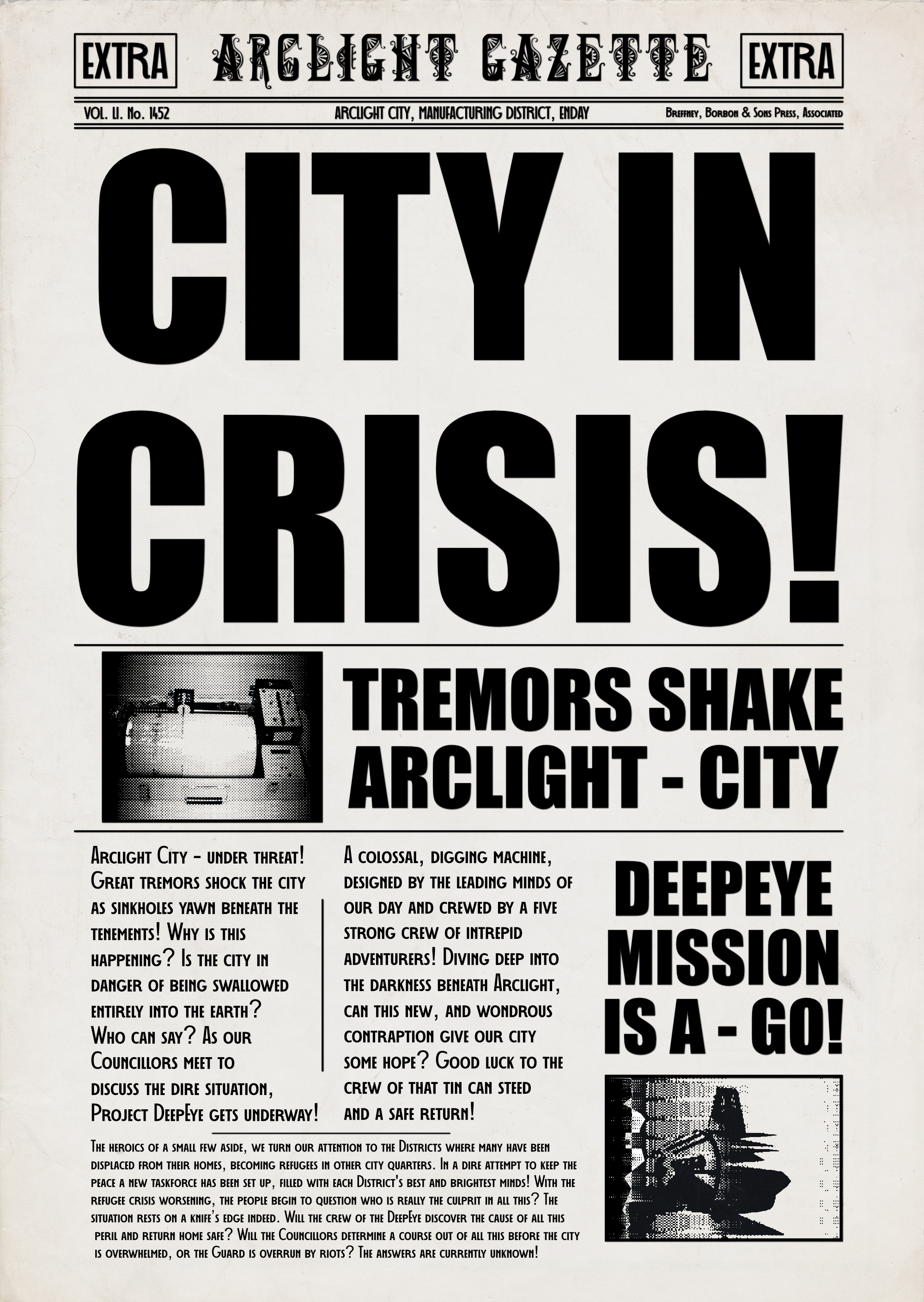
Arclight City - under threat! Great tremors shock the city as sinkholes yawn beneath the tenements! Why is this happening? Is the city in danger of being swallowed entirely into the earth? Who can say?
As our Councillors meet to discuss the dire situation, Project DeepEye gets underway! A colossal, digging machine, designed by the leading minds of our day and crewed by a five strong crew of intrepid adventurers! Diving deep into the darkness beneath Arclight, can this new, and wondrous contraption give our city some hope? Good luck to the crew of that tin can steed and a safe return!
The heroics of a small few aside, we turn our attention to the Districts where many have been displaced from their homes, becoming refugees in other city quarters. In a dire attempt to keep the peace a new taskforce has been set up, filled with each District's best and brightest minds! With the refugee crisis worsening, the people begin to question who is really the culprit in all this?
The situation rests on a knife’s edge indeed. Will the crew of the DeepEye discover the cause of all this peril and return home safe? Will the Councillors determine a course out of all this before the city is overwhelmed, or the Guard is overrun by riots? The answers are currently unknown!
💡 About the Game -
Fault: Arclight City is a steampunk themed Megagame of negotiation, cooperation and catastrophe.
The game runs over the course of a single day, with an arbitrary end time that is defined by the choices which Players will make during that session. A game of Fault will see ~25 Players take on various roles in the leadership of Arclight City and the DeepEye task force, attempting to mitigate, and perhaps stopping the catastrophe that is unfolding beneath their feet.
Some of these roles will be in the leadership council of the city who are attempting to forge a path out of their dire situation, or range to other vocations, such as the city guard who are tasked with managing the growing unrest and refugee crisis. Others will crew the DeepEye itself, searching for answers about the origin of the disaster, deep below the city streets.
The Players should remain wary, however, as each individual has their own agenda, and some may not have a vested interest in the truth ever resurfacing.
👀 What Does a Game of Fault Look Like?
As a Megagame, Players in Fault will receive several briefing documents about their role and the world that the game is set in. These will concern their personal and factional objectives before the commencement of the game and Players are allowed to interpret their objectives as they choose, so long as they conform to both the spirit of the game as well as the game mechanics which are outlined in this handbook. Some Players will find that they are in accord with the global objectives as outlined in the narrative, while others may have secrets preventing them from being truly trusted, or trustworthy.
On the day the majority of Players will spend their time in a large hall space. They will have their home table area as well as a selection of other stations available to them. These can be visited at any time, though will only be interactive during certain phases of the game. The game will proceed in turns, each of which is broken up into several phases. A standard game will see a maximum of around eleven turns and go for about five to six hours. During each of the phases in a turn, Players will generally be pursuing their specialisation and objectives, working towards their factional or personal goals, while also interacting with both the story and game mechanics as they develop.
Fault is not specifically a role-playing game but does include some role-playing elements and Players are able to interact with the lore of the game as much, or as little as they would like to, within the bounds of the mechanics. A general recommendation is for the Player to play ‘Themself, as their role,’ rather than crafting a character for themselves if they are uncomfortable acting and roleplaying in the traditional sense. This is of course a recommendation only and Players may interpret their position and ‘character’ as they like. Both the story and the mechanics of the game will be outlined in this handbook, as well as in the individual briefings which Players will receive before the event day. Anything mentioned specifically in those briefings is 'true' and any white space left around them is for the Player to fill in.
Some Players will be given the role of crewing the DeepEye, a colossal digging machine which will have its own mission and mechanisms. These Players on the Digger Crew team will be out of contact from the majority of the Player cohort for most of the game, conducting their own mission and communicating only sporadically with the various heads of communication on each of the other teams. Depending on how ticketing is done for any one run, Players will normally have the ability to indicate their preference for whether they would or would not like to be considered for these kinds of roles, on the casting survey which will be sent out before the game day.
🚂 The Control Team -
Helping to facilitate the game will be the Control Team, a group of referees who will be on hand to help guide negotiations and make rulings on disputes concerning any arbitrary resolutions or conflicts. The day will be led by the Showrunner(s), who will introduce themselves before the commencement of the game and who will also introduce the rest of the Control Team. The Showrunner has the final word on how the game progresses and is, as the name suggests, able to run the show as they like. Other Control Team members will also be helping to define the narrative and mechanical progression throughout the game and Players may go to anyone on the Control Team with suggestions and for clarification throughout the day.
The Control Team are not Players in the game and should be considered impartial. Players who wish to accomplish anything outside of the normal rules of the game should bring those plans to a Control member, before putting them into action. In Fault nothing is considered ‘real’ or a fact, until a member of the Control Team is aware of it, and has given verbal ascent. Even then things may not go the way that a Player expects and they should be prepared for that. The Control Team will seek to, beyond all other resolutions, facilitate the outcome that helps the most people have the best time while playing the game.
This means that the Player should expect to succeed in some things at a cost, and fail interestingly, in ways that they had perhaps not expected. No one is the ‘main character’ in a game of Fault and any schemes or other actions that stand a chance to negatively affect another Player’s experience with no counterweighting or ability to respond, will be largely ignored by Control for the purposes of narrative resolution. In Fault, if Control says something has happened, then it has and no Player may impose a reality on another Player without Control’s consent.
This being said, Control are still human and will attempt to be consistent in all rulings. Players may, politely, seek clarification on any decision that they don’t understand or have a different understanding of, and Control reserves the right to recant a previous decision if it was made in error or without complete context. Fault is an exercise in collective storytelling and is a two way dialogue, to the limits imposed by the above statements.
🌆 Setting Primer -
Set in a steampunk fantasy world, Fault: Arclight City follows a crisis inside the eponymous Arclight City where great tectonic shifts have begun to rattle the ancient stones upon which the city is built. Sandwiched between a bleak wasteland and an untraversable sea, Arclight City, stands alone. A bastion of civilisation in a world that can see no further than the last skin of water to the east, or as far the furthest sailors dare challenge the boiling waves in the west.
If the venerable city is to survive, they will do it on their own.
For now, sinkholes swallow famous boulevards, while earthquakes sheer whole buildings in half and the people there are left homeless and afraid.
Arclight is an old city, one that has had a long history of social and demographic unrest. The current ruling council, artefact of the last populist uprising, has ushered in an age of unprecedented prosperity on the back of huge leaps in arcano-scientific advancement, largely due to the city’s discovery of a volatile energy source known as Vortonite.
The City itself is divided into the five major Districts, each of which has a long history of its own and a voting chair on the City Council. With ancient allusions to inseparable unity, the five Districts also hold significant rivalries amongst each other that go deeper than mere sibling quarrels. As the current emergency unfolds differently for each District, these scars are becoming tears in their long term alliance, leaving questions as to each District’s responsibility to the others. For now, the Council appears to understand that strength in the face of this disaster can only be had through unity, but soon there will come a time where hard choices must be made for the good of all. Or perhaps only some? This, is yet to be realised.
With buildings crumbling in the city daily, and the ancient walls that hold back the raiders and wasterals of the badlands showing signs of following, even the Guard has begun to take matters into their own hands. Practicality has started to come into conflict with politics, and rhetorical lines are being hastily drawn.
All the while, the great minds of the City’s scientific community have been hard at work constructing Project DeepEye, a colossal digging vehicle that can take five intrepid crew, deep within the earth beneath the city to discover, and perhaps halt the spread of, the origin to the current crisis.
Players will take on roles ranging from Councillors for their District through to Crew aboard the DeepEye Digging vehicle and the Surface Task Force. All with complex and sometimes diverging motivations. One thing remains true for all, however; If the city falls there would be nothing left for anyone who survives. As the crisis itself grows ever more dire, the city begins to whisper that terrible question, “Whose fault is all this mess, really?”
♟️ Game Map -
🦴 Anatomy of the Game -
A game of Fault will go for a number of hours, the eventual running time being determined by the choices made, by the Player cohort on the day. A game will not normally go beyond eight hours and the Control Team will announce to the Players when they have entered the final turn, giving them the opportunity to enact any plans in progress before the end of the day. Following the final turn will be the Epilogue where the Showrunner will describe the outcome of the Player’s collective efforts. This could be positive, negative, or ambiguous depending on the Players’ collective choices throughout the day.
Once the game has commenced, Control will start a turn timer which will not stop again until the end of the game. This is excepting some circumstances where the game time is paused for administrative or emergency reasons. Normally in Fault, there will be a double length turn during the middle of the game where the same number of actions are fit into double the time, and where nothing progresses in the game narrative. This is to allow those who need, to disconnect from the game, to take medication, eat food, and hydrate, etc. This time is designed to give Players some lower intensity minutes and it will coincide with lunch, otherwise, there will be no official lunch break.
During a normal turn, Players are welcome to leave and return at any time but the game will not stop and any opportunities missed will be, just so. Players are encouraged to use the double length turn as it is intended, there will be no additional game actions beyond negotiations with other Players that they will be able to affect during that time. No additional councils will be held during the double length turn, and no additional communication with the DeepEye will be possible. Players will not miss anything special if they finish their actions for that turn and take time to rest until the game recommences.
For the Surface Task Force Teams, each turn of the game is broken into the following phases:
| Phase Name: | Description: | Duration: (min) |
|---|---|---|
| The Organisation Phase | Discussion/Team Time/Announcements | 10 |
| The Specialisation Phase | Carrying out Specialisation Tasks | 15 |
| The Debate Phase | Hearing Update and Debating Policy | 10 |
| The Voting Phase | Voting on Policies following Council | 5 |
| The Communications Phase | Player Negotiation and Communication | 10 |
The First Turn and the Briefing Phase -
At the commencement of the game there will be a one time, additional turn before the regular cadence of the game begins. This will include a quick whistle stop tour of each of the stations that the Players will be interacting with, followed by the sending off ceremony for the DeepEye Crew. During this Briefing Phase the turn timer will not be running and the game will only be considered to have commenced at the start of Turn One and the Organisation Phase.
The Organisation Phase -
This is time for the District Players to gather at their District, or Team Table, where they can plan for the upcoming turn and initiate any plans that they may wish to enact. In subsequent turns this is also the time where announcements will happen including any changes to the game broadly and notable events. This is also when any crisis events will be announced with the effects to each team/department.
The Specialisation Phase -
This is the longest phase and the only time where Players will have to engage with their speciality roles, as dictated by their personal briefing documents. More information on a per-role basis will be available within the briefings. The Councillors will meet with any of their established coalitions and visit the other speciality departments. Councillors may also begin drafting policies to be voted on later in the turn. The Head of Communication will begin to establish the contact mode and location for the DeepEye in the current turn and relay any replies from the Digger Crew that may concern the other specialities. The Chief Scientists will interpret their data about where the next event may occur and begin work deciphering the mystery of the crisis. The District Guard Captains will survey the turn’s damage and try to mitigate the security and humanitarian situation in the fallout.
The Debate Phase -
The Debate Phase is a time for each team to announce their current situation to the council through a selected representative and make any specialist recommendations for that turn's policy. Anyone who attends the Council in the debate phase may speak, so long as they are recognised by a sitting Chair. Draft policies may also be announced and debated in this time. No outcome can be voted on unless it is drafted as a policy, with a sitting Councillor’s approval. At least one member of any specialisation must attend the Council, every turn.
The Voting Phase -
Once the ten minutes for debate has elapsed, the Council will enter the Voting Phase where each, amended policy is put to a vote. The votes are processed in the order decided by the siting Chair person for that turn, before the vote is taken. More details on how the Council is run can be found in the related section later in the hand book.
Other Players may remain to watch the vote, or depart early. Successful policies will become Council Decrees and be announced in the following turn’s Organisation Phase. During the Voting Phase the current turn’s communications mode to the DeepEye is still open, only closing at the end of the following Phase, allowing passed decrees to be communicated to the digger in the Communications Phase, if there is time.
The Communications Phase -
This is an important Phase for the Task Force Communication Officers as it is a time where they can relay their information from the other Specialisations, as well as active Council Decrees to the DeepEye, and vice verse. For other Players this phase is largely open, to allow for either inter-team communication or the preparation of other actions in the following turn. Other Players may approach their Communications Officer if they would like to make a broadcast to the city, or send a message to the digger themselves. Details on how to communicate with the digger are explained in the Communications Officer rules.
🗺️ Example Venue Map -
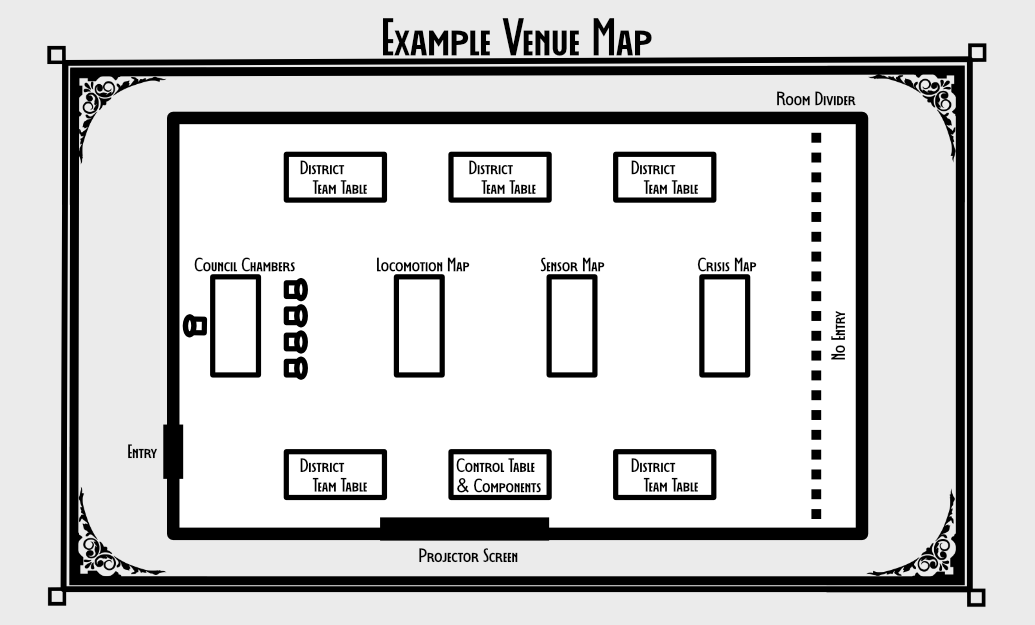
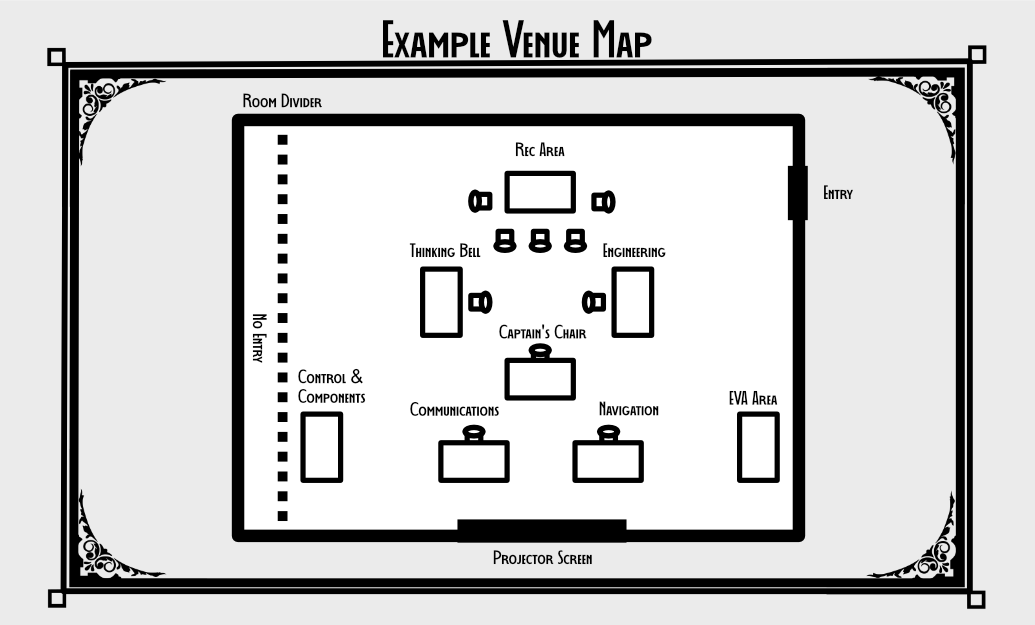
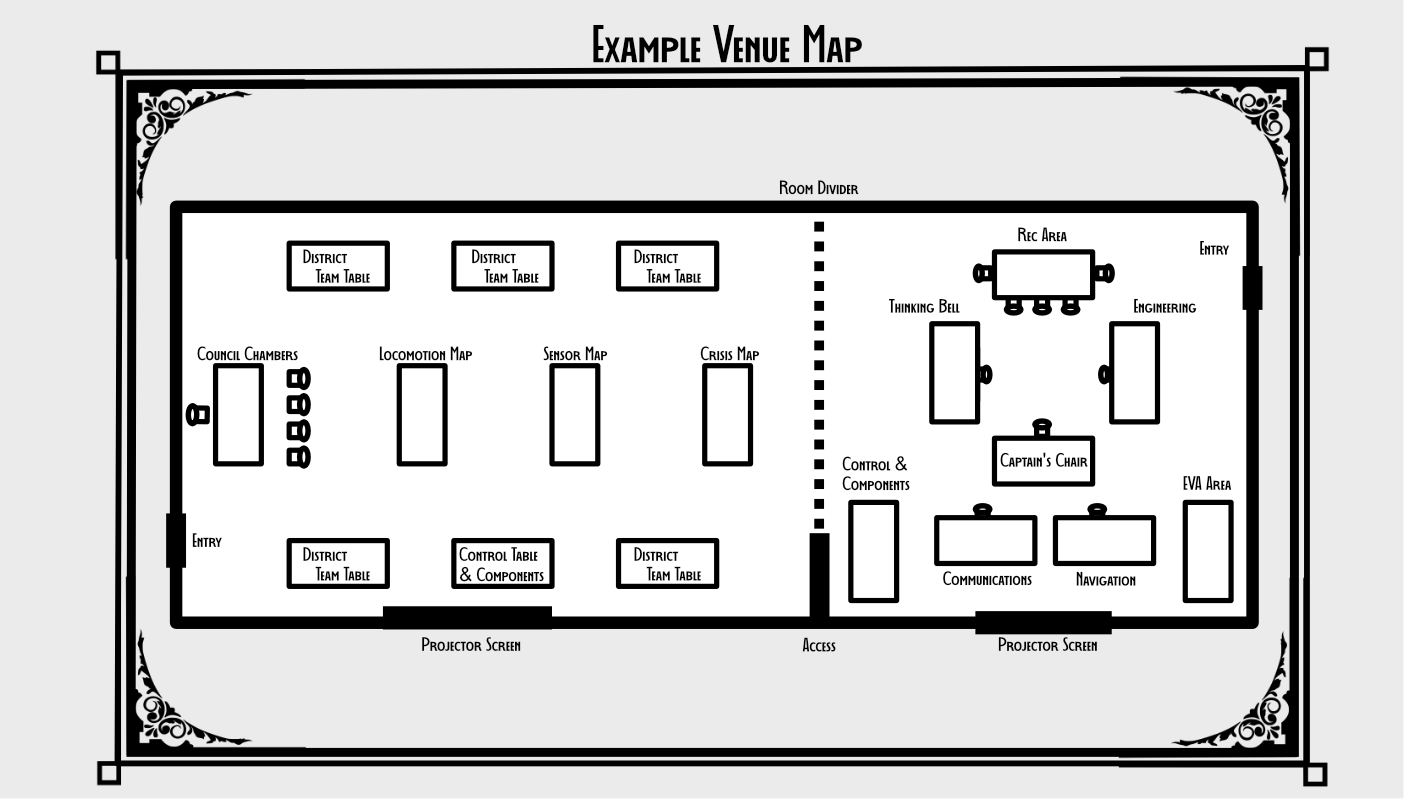
This is an example venue layout only, and will be subject to change from run to run of the game.
❓ Specialisation Roles -
District Teams -
As a member of a District Team and the DeepEye mission's Surface Task Force; Each Player will have their particular responsibilities, as defined by their role in the team, and their independent briefing. Factional Briefings are shared while Personal Briefings contain priveleged information than should be kept secret, even from fellow team members. On each District Team are the roles for; District Councillor, Head of Communications, Chief Scientist, and District Guard Captain. In Arclight City there are five main districts; The High Spire, The Tenements, The Green Terraces, The Harbour, and The Manufacturing Quarter. Each of these Districts has its own identity, history, and own loyalties. For many years the city has been held together based on the mutual arrangements between these fractured families and their general willingness to cooperate. Bringing, relative, prosperity to each of it's people, the city of Arclight has stood in harsh contrast to the privations of the world outside and the Outcast class who cling to the City’s wall. Those bonds, however, have become strained by the current crisis, with some Districts being hit sooner and more aggressively than others, causing a citywide refugee crisis. While overtures of fraternity and solidarity have been made by all groups, the fact remains that while more and more of the city is lost to the tectonic activity wracking the Districts, there are fewer resources to go around and more mouths to be fed. While hope rests in the DeepEye expedition to find a solution to the crisis, the Districts have a more immediate and practical timeline which they must give their attention. Specific guidance will be given to the Players in each role from their personal briefing and role summary. Following will be a short overview of the responsibilities for each role in a District team. Players should note that Fault is a living game and responsibilities that they have at the start of a game may have changed by the end.
The Councillor Role -
The Arclight Provisional Council is the oldest institution in the city, having been formed after the last, populist revolution where the city’s ruling class was overthrown by a coalition of the current incumbent’s ancestors. Even so, the protagonists ranged from academia, through to the lowest wage worker and a new, meaningful system of government had to be put into place in order for the city to not collapse in on itself during the aftermath. Unfortunately, no equitable system was ever found that could satisfy all the major stake holders, or replace the ad-hoc, interim council which had formed to discuss such matters. Many hundreds of years later, the current Council persists, a descendent of that interim court that has metastasised as the only, most efficient form of governance that most of the city could tolerate. As a Councillor for one of the Districts, the Player will negotiate with the other representatives, in Council Chambers to resolve the current crisis. With the emerging refugee, starvation issue and each District beginning to play power games, the Councillor Player will have to navigate a web of competing motivations to move the needle, or get anything done.
Each Councillor starts the game with a voting power of one. Each time that they vote on a policy in council that succeeds, their voting power will go up by one. If they support a policy that fails, their voting power will remain the same. This is to indicate their support from the city and the influence which they have over the people as a whole. Councillors, when not in session will have time to move about the other stations, either to see the state of the city with their own eyes, or to make sure that their resolutions are passed as intended. Sabotage would, of course, be beneath them. Councillors with surplus voting power may use any number of their voting power while above one, to influence an outcome in the other specialisations. This is, one of the only times where their voting power may go down and should be done with caution for that reason. Councillors may otherwise not compel any Player to follow their wishes and must use negotiation and incentive as a tool to seeing their will done.
District Head of Communications -
Arclight City is gridded with a huge network of rails and junctions that service the civil train-lines. As a part of the DeepEye mission, a colossal antennae has been built and installed in one of the city’s trains, in order to help the mission stay in contact with the digger and it’s crew. The Head of Communications for each District are in charge of communicating with the ongoing DeepEye Mission. Communications will vary throughout the game and the Communications Players will need to be always ready to adjust on the fly. Several different channels will be open to the Communications Player in order to get their message out. Which one is used will depend on how proximal they can keep their antennae to the DeepEye vessel. During their Specialisation Phase the Communications Players will be working together to coordinate any orders given from the Council, with the responses from the DeepEye, as well as reporting the outcome. In addition, Communications will need to try and track the DeepEye’s location to help them navigate to the areas of interest or those with the most urgent need for intervention. Communications will be a busy role that requires the parsing and interpretation of a lot of information. The District Heads of Communications will need to be able to summarise all of that information and communicate actively with the other specialisations in order to make sure that the instructions issued to the DeepEye will make sense and help with their mission.
District Chief Scientist -
The Chief Scientist Role, in their specialisation will take on two competing priorities during the game. Firstly, and most immediately, they are responsible for interpreting the seismological readings taken from their telemetry balloons, in order to anticipate the next string of disasters in the city. Secondly, they must attempt to track the DeepEye's position and share that information with interested parties. Between these two mandates they must also coordinate with the City Guard in order to move refugees and residents out of areas about to suffer an incident, all the while transmitting the areas of interest to the DeepEye, through the Communications table. The DeepEye can potentially mitigate some of the damage to different parts of the city, if they get there in time. Science is an active role that requires a lot of inter departmental collaboration. Players taking on this role are advised to keep an eye on their subordinates as each Chief Scientist comes from somewhere in the city and it would not be hard at all to play favourites now and again. All surface Players are in the unenviable role of having to pick in any one turn, which residents may have the chance to live, and who is going to be sacrificed for the greater good of the city. If the Chief Scientists do their jobs right, few hard choices will have to be made. Hopefully that choice doesn’t become political…
District Guard Captain -
The District Guard Captain role will see Players dealing with the refugee and infrastructure crisis ‘on the ground level.’ Politics is one thing but when it comes to action, as well as people’s lives, somebody has to make a call in the moment. Guard Captain Players will receive information about impending incidents and be forced to reckon with the least bad of the worst options, more often than not. The District Guard Captain is responsible for moving people out of the District streets which are either under impending disaster or those that can no longer support the amount of people within them. In addition, the Guards can recruit Outcast work teams from beyond the city walls in order to clear rubble and make space for refugees. This all comes at the cost of increasing the refugee population of the city overall and decreasing the stability of the civil order. Guard Captain Players will be balancing the needs of the city, the people, and the crisis. Often being forced to compromise in ways that may not be ideal. The Guard Captain Players are also needed for communicating the needs of the city to the other specialisations, and are responnsible for holding the city together while a solution to the crisis can be found.
🧑⚖️ Specialisation: District Councillor -
District Councillor – High Level Organisation, Taxation and Legislation
Technically separate from the Task Force, though in possession of more deciding power, the Councillors of each district are responsible for attending the Council chambers and voting in sessions there to pass emergency decrees during the crises. In addition, their position as District leader has them distributing the funds that they receive through taxation, in order to help mitigate the damage caused by the crises.
Councillor Players are likely the most partisan Players in the game, thinking of the entire city second to the survival of their own district. The District Councillors are leaders and masters of the city inner workings, and they know that to get anything done, it requires funding. Their power is both implied by their position and enforced through real financial support to the different specialities in the task force. The Councillor role sees the Player not attending a Specialisation of their own, and instead has them negotiating and moving through the other Player’s spaces to put their thumb on the scale at precisely the right moment. They are duty bound to help the cause of saving the city, but surely the primacy of their own district serves as part of that? After all, the more power they accrue, the more good that can be done.
Demarcation -
Each Councillor Player starts the game with a voting power of one, represented by a physical token. Each time a vote goes their way in the council, that voting power will be increased by one. Every time that they are on the losing side of a vote, nothing happens. Voting power increases the number of votes on any policy for the side that they support. In this way Councillors are incentivised to vote with the greater good, and to align themselves with other colleagues who have proven to have the right in most circumstances. Perhaps there will be a right time to break from the pack and consolidate their own district’s power?
Taxation and Funding -
Each turn, depending on the health of their own district, a Councillor will receive an amount of taxation in their coffers in the form of the 'Funding' resource. The amount of this resource varies district by district, and will fluctuate further, based on the 'condition' of their citizens. Taxation is a District privilege and only the Councillor from a District can decide what happens with that District’s collected revenue. Each of the Specialisation Players within a District team will be appealing for funding during the following turn, so it is important for the Councillors to consider carefully where their funds will go for best effect.
Calling in Favours -
Considering their tremendous influence in the city Councillor Players will be able to rely on their networks of friends and favours to get things done where otherwise they may not be possible. At any time that the Councillor Player wishes to affect a result, aka; get additional information, reverse an unfavourable affect, they may ask Control to lower their voting power by one in order to influence the outcome. The exact outcome will be up to Control to decide, but by placing a thumb on the scale in this way, Councillors may be able to turn a decision when it matters most. Councillor Players must retain at least one voting power and may not call in a favour if doing so would leave them without at least one point in voting power.
Council Meetings -
During the Specialisation Phase, the Councillor Players may meet, either together or in subdivisions to discuss the future of the crisis and the state of the city. This is while the other Specialisations will be conducting their work for that turn. In this time they may draft policies which will be voted on in the Voting Phase. These policies can be anything from additional resources for a particular team, to emergency powers being given to a single council member. Like with calling in favours, if a vote is passed, the exact outcome will be interpreted by Control depending upon the story and circumstances but follow the spirit of the policy. Being more specific, will lead to a more specific result, whether that is desirable or not. Any policy that affects particular sections or Players will be left up to those in question to interpret or implement. Control will enforce legitimate changes to the rules, if successfully passed, but will never compel another player to acquiesce if a decree is using soft power. In such cases, enforcement will be left up to the Councillors to organise.
If a policy fails, nothing comes of it and any resources spent in furthering its chances are consumed. If a Councillor Player votes on a policy that subsequently passes, their voting power will increase by one. Decrees can change much about the game, including rules and rewards, should the policy be appropriately worded and supported. As a point of clarification; Policy, is the paper/missive suggesting a Decree. The 'Decree' is the passed law, should the policy vote be successful. A policy can reverse a decree.
The Chair -
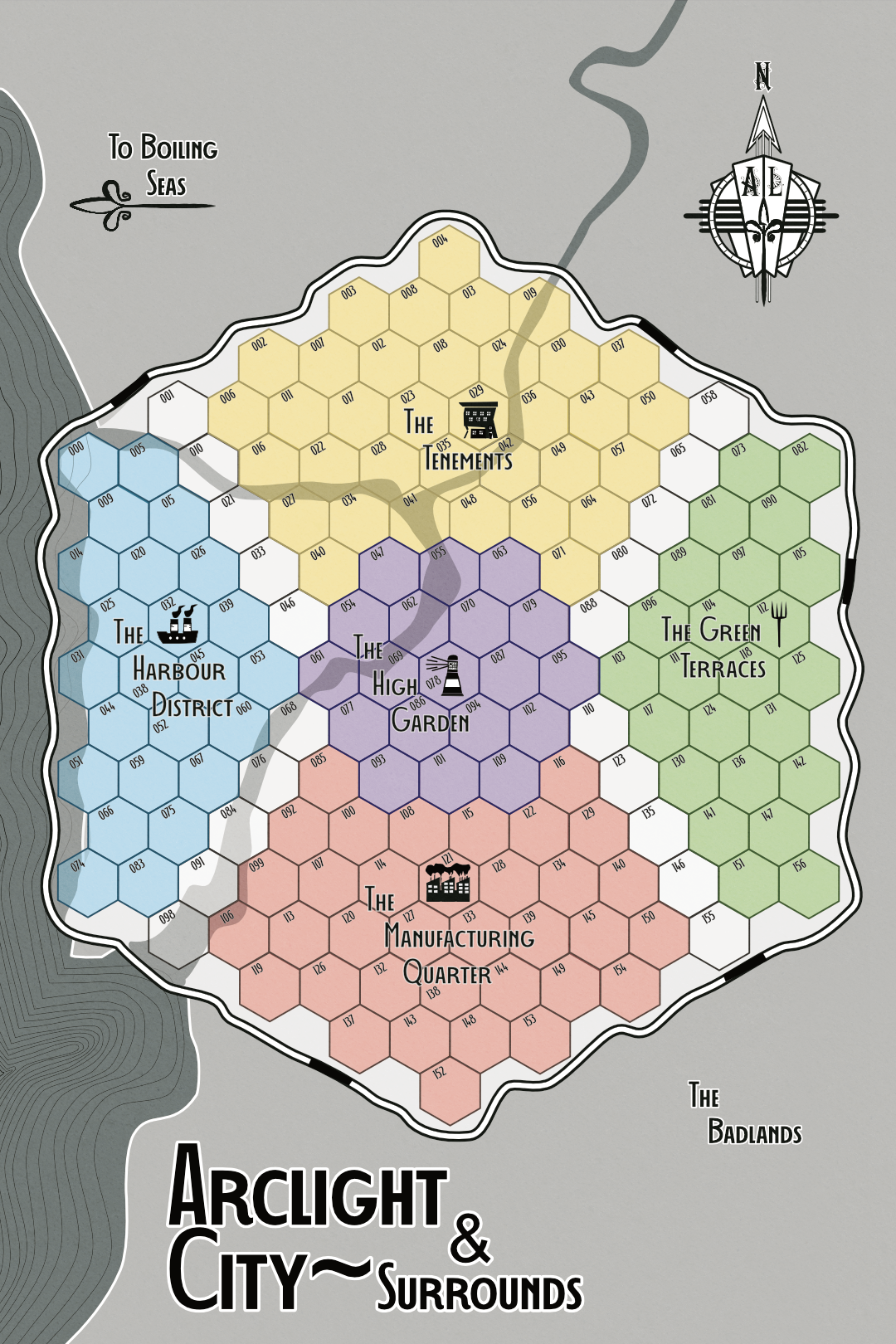
At the start of the Debate Phase, the Councillors must all meet to elect a Chair for that sitting of the Council. The Chair role is able to manage the session, organises the order of policies on which to vote, and selects who will be allowed to speak, and who will not, in council. The sitting chair also selects, where the council sitting will take place, selecting a hex block on the city map to hold the session. At the beginning of the Organisational Phase, the Chair also announces any policies that have been passed during the previous Voting Phase, to the room at large. After the announcement, their powers are removed and a new vote must take place for the proceeding turn.
Votes for the Chair count towards increasing voting power. If the elected chair is not the Player with the most voting power, the Player with the most voting power may select one policy to discard before the vote takes place.
Voting Power -
The Voting Power Resource is abstract, meaning that it represents more the gravitas of the Player, rather than any particular possession. This means it is not possible to lie about how much voting power a Player has in council. If a Player is found to actively lie, Control will remove the reported number down to what they said, if understated, or if they overstate, the surplus over their actual power will be removed from their actual holding.
Funding -
Each District collects taxes for funding in a different way, and the amount that the Councillor will have access to will fluctuate based on different metrics, as outlined in the faction briefings. This is a diegetic resource, meaning that any Player may conceal, lie, or otherwise represent their total wealth in whatever fashion that they like. That being the case, they must still fund the Task Force, if their District is going to be represented in the other parts of the game. It would be wise for the Councillor Player to speak to the other members of their team and plan how much funding needs to go where, each turn.
🛡️ Specialisation: District Guard Captain -
District Guard Captain – Population and Disaster Management:
At the start of the game there will be a layout in pieces, placed on the city Crisis Map, by Control, described in tokens. This layout will represent the population of the city. Some districts will have more populated areas while others will have more space available.
During the Specialisation Phase all District Guard Captains will attend the Crisis Map table. Their role during the Specialisation Phase is to find the most optimal distribution of population and displaced refugees, in order to manage the clearing of infrastructure damaged by the crisis points which will arrive on the map, each turn. The Scientist specialisation is responsible for determining the location of the next crisis events and for distributing that information to the District Guard Captains before the next turn when the destruction will take place. If the Scientist team has managed to locate the next crisis points, the Guard Captains should know where the next crisis will take place, in order for them to take appropriate action. This information will take the form of hex map coordinates.
Distributing Population -
At the start of the game there will only be ‘population’ markers on each of the hexes within the city map. Each hex is referred to as a ‘hex block’ for the purposes of these rules, aka; a ‘city block’ for scale. Some areas will also be clear of population, following the starting layout rules. The Crisis Map will track the affect of each possible crisis on the population and infrastructure of the city. Crises, when they occur, will be centred upon a single hex grid coordinate, and based on the magnitude of each crisis, that will define a radius which affects either a smaller, or larger area.
Ideally, this information will have been passed to the Guard Captains by the Science team, or some subset of that information from the previous turn. In order to respond to the crises, the Guard Captain Players must locate the hex blocks that will be affected by each crisis and negotiate, amongst themselves and in reference to the Council’s mandate, the best outcome for the most people. There are a few rules dictating how population and refugees may be moved around the city;
- Each hex can only ever hold a maximum of two tokens of any type.
- A population token can be moved, once per turn to any adjacent hex block, that has room left to house it.
- Population may be moved voluntarily, further than one hex block away from its origin in that turn, but if they do so, that token will be converted into a refugee token.
- If a population token is ever forced to be move by a crisis point, or from lack of space, rather than being intentionally moved by the Guard Captain Player, then it will be converted into a refugee token regardless of the distance that it moved.
- Refugee tokens can only be converted back to population tokens if they are moved, intentionally into an open space, which contains no unrest or, infrastructure damage tokens.
Avoiding Crisis Points -
When the Guard Captain Players become aware of a potential crisis, they can choose to move the population, out of the hex block where the crisis will take place. The population token is moved into any adjacent hex block, keeping the population movement rules in mind. Larger crises will affect a greater area, and so it may be prudent to move a population further than one hex, in order to clear them from the affected zone. The population movement rules, then dictate that any population token moved like this will be converted into a refugee token. The Guard Captain Players must try and run the balance between, creating refugees and leaving populations in peril. Any population that is still in the range of a particular crisis at the end of the Specialisation Phase will be affected by that crisis, and removed.
Each time that a hex block is hit with a crisis, that hex block will be given a number of infrastructure damage tokens. These tokens count towards the total number (two) of tokens allowed in each space. Minor crises will usually only create one infrastructure damage token per hex block, while more severe crises will create two at its centre with fewer on the outer hex blocks surrounding it. If a population token is still in an affected hex block when the crisis is active, if there is enough space, the infrastructure damage token will be added.
If the hex block is either at capacity or suffering a major crisis, the infrastructure damage tokens displace any number of population or refugee tokens present.
If a population token is displaced by a crisis, it becomes converted into a refugee token and moved to an adjacent hex block. If a refugee token is displaced, it becomes an unrest token and is moved to an adjacent hex block. If there is no space adjacent to the displaced hexes and either a refugee or population token must be moved, then the token is destroyed and removed from the map. Removal indicates destruction amongst the population due to the crisis.
Seeing as each hex block may only ever contain two tokens of any type, this may cause a ripple effect across the city. Guard Captain Players are advised to stay vigilant to any potential chain reactions which may occur.
When a refugee token is made to move involuntarily, they become an unrest token, indicating that the civil order where that token rests has broken down. Unrest tokens cannot be displaced or moved and if they otherwise would have been, are removed from the map instead.
If three or more refugee tokens are in adjacent hex blocks, they will be automatically converted into unrest tokens with the associated rules. If three or more adjacent hex blocks contain unrest tokens at the end of the Phase, then all affected unrest tokens are converted into infrastructure damage tokens. Please refer to the ‘Adjacency’ rules to determine whether or not any hex blocks may be affected.
The Affect of Unrest and Population Death -
If a district contains unrest tokens, or has suffered population death in the previous turn, it can affect the morale, as well as taxation potential, for the entire district. In this case Guard Captain Players should expect to hear from their Councillors as it will have ramifications beyond the Crisis Map.
Catastrophic Failure -
If three adjacent hex blocks are fully damaged, i.e. contain two infrastructure damage tokens each, then each subsequent turn where that continues to be the case, an additional infrastructure damage token will be added to all adjacent hex blocks. This represents the city being slowly swallowed into the sinkhole. Please consult the ‘adjacency’ rules to see what may count for the purposes of this ruling.
Clearing Rubble and Rebuilding -
Infrastructure damage tokens can be cleared at the beginning of the Specialisation phase, by moving a population token into a hex block containing at least one damage token. When doing so, one infrastructure damage token is removed per population token that is moved into place, in order to replace it. This means that even if the hex block is at capacity, this is a valid action due to the fact of the tokens replacing the existing token rather than adding to the total number of tokens on the hex block. Refugees cannot clear infrastructure damage tokens.
Adjacency -
For the purposes of both refugees going into unrest and for the spread of damage under the ‘catastrophic failure’ rules, adjacency is considered to be happening when three or more hexes meet the occurrence’s other requirements, while also having at least two of their sides in contact with the other hexes meeting that criteria. Adjacency is calculated at the end of each Specialisation Phase and the effect will be applied before the start of the next Specialisation Phase.
Funding and Civil Orders -
The way a Guard Captain Player interacts with the Crisis Map is to fill out their Civil Order Form. These will be available either at team tables or at the Crisis Map and will have sections covering movement from one hex coordinate to another as well as a notes section for context giving. These forms may be delivered to Control anonymously, and the outcome will only be revealed upon its execution in the Specialisation Phase. The amount of actions allowed on the Crisis Map in a turn will be determined by the amount of funding given by the Player’s District Councillor. If there is not enough funding for a District to carry out all of the orders listed, then Control will execute the actions on the Crisis Map, in numerical order, top to bottom, until the funds are exhausted. The other action will be discarded, that turn.
Jurisdiction -
Civil Orders are only valid if the origin point is within either the Player’s own District, or originates in a non-District slum (uncoloured spaces on the map). Orders may move tokens into other districts, so long as they originate on their own colour or an uncoloured space.
🧑🔬 Specialisation: District Chief Scientist -
District Chief Scientist, Research and Forewarning -
The District Chief Scientist is responsible for deploying sensors on the Sensor Map in order to predict the location and intensity of the next crisis events within the city.
By attending the Sensor Map table in the Specialisation Phase the Chief Scientist for each District is able to use any budget that they have been allowed by their Councillors, in order to deploy ‘Sensor Balloons’ above the city which can sense the potential for any seismic events about to occur. Depending on their district’s funding and how much is allowed to each scientist in a turn, the radius of their sensors will be larger or shorter. The Scientist Players will receive their results in confidence from Control and can choose to share their data, in the form of a direction/bearing from their balloon. With the help of their colleagues, they can cross-reference the locations where the sensors detect a disturbance and potentially forewarn the city of coming crisis points. The sensors are also capable of picking up on the magnitude of each potential crisis and by matching the waveforms detected, they may even determine whether the event is minor, major, or if in fact they are tracking the DeepEye digging platform itself.
Science Funding -
Science is, unfortunately, at the whim of the city’s purse strings, even in a crisis. Each District leverages it’s own taxation and there is no central mechanism for allocating funds in a District agnostic way. The Chief Scientist role must always make time to take their case to their District’s Councillor in order to secure funding. Though the other Specialities may seem more immediate, Science is where prevention can begin and with more funding, that prevention can become more targetted and accurate. Each turn, in the Specialisation Phase, each Scientist will get to placed one ‘Sensor Balloon’ on the Sensor Map. By default all district scientists have a single point of funding called their ‘Grant.’ This Grant allows enough detail for each balloon to tell its operator whether there are signals to either side of the hex space that it is placed in on the Sensor Map. Each turn wind direction is important to note as the balloon will follow that line from its starting point across the city. Following one row of hex blocks on the map until exiting. By placing the balloon strategically the Scientists will be able to triangulate the location of the the various signals. Between each placement, the wind direction will be changed - making the order in which the balloons are released important as well. With additional funding the report from the Sensor Balloons can become more accurate; • With two funding, i.e. the Grant and one additional funding from a District Councillor; the balloon can report on the primary cardinal directions to any signal. North, South, East, and West. • With three funding, Grant inclusive, the Balloon can also report minor cardinal directions; NW, NE, SW, SE. • With four points of funding, Grant inclusive, a balloon can report the depth of the signal, in addition to the direction. • Finally, with five points of funding or more, a balloon may report; Direction, Depth, and Distance of a potential Crisis from the balloons trajectory.
Scientists will receive the results of their balloon’s sensor scans in private and can choose to collaborate, or not, with the other Chief Scientist Players in order to help triangulate the location of the next crises. Players may find that Districts allocate an uneven, yet still insufficient amount of funding in any one turn making collaboration more or less attractive to particular districts in a particular round. Players are advised to be cautious, while also not burning bridges. The safety of the entire city is in peril after all, not just each Player’s home Districts in isolation. Balloons can only be place, to begin their flight in a Scientist's own district without explicit permission from the Council.
In addition, altitude matters. There will be high buildings on the Sensor Map with a number showing how high the balloon must travel in order to fly over them. Every level that the balloon is above the standard '0,' will mean a less accurate reading on its sensors, aka; One funding level below the paid level that turn. If a balloon collides at the same level as a building it will stop its traversal of the map. Buildings may be removed by infrastructure damage, as the game progresses.
Signal Processing -
Once all signals have been triangulated, or narrowed down to the best of the Player’s ability, for the current round; Players will have the opportunity to attempt to diagnose the signature for each signal. Each detected signal will need to be identified if the Players want to learn what kind of signal it is rather than just its exact/approximate location. For each signal that they are aware of (that they have detected) Players can submit a ‘waveform,' trying to match the ‘frequency of each signal. Control will have a collection of these waveforms, one for each signal that is detected and the Chief Scientist Players must assign a magnitude to each section, of five, in order to fill in the correct signature.
Per signal, each Chief Scientist Player, who is aware of the signal, will have the amount of attempts/guesses, equating to their level of funding for that turn. Grant only will give one guess to a Player, per signal; Two funding will give two and so on. Because it is unlikely for the Chief Scientist Players to have perfect funding, and perfect guesses in every round, they are heavily encouraged to collaborate in order to increase the amount of guesses on each signal.
If a correct magnitude is guessed, by a Player, in the correct location of the waveform, Control will reveal this information to the guessers and any other Scientist Players who are aware on the same signal. If the guess is incorrect, the Player along with other Scientists aware of the signal in question, will be told how many times in the signal, that magnitude appears, if any.
The possible magnitudes are;
      ▪ +1, or Minor Positive,
      ▪ +2, or Major Positive,
      ▪ -1, or Minor Negative,
      ▪ -2, or Minor Negative,
      ▪ 0, or Flat
If the Scientist Players run out of guesses before they fill in the five spaces on each signal they will have to pass the incomplete information on at the end of Phase. When complete, a signal will show, either more minor or more major magnitudes, which will indicate to the Players whether the event is a major or minor one. This is essential information to be passed along to the Guard Captains, as they will use that information to help direct evacuations for the affected parts of the city.
The DeepEye, digging platform may also show up on the Science Team’s sensors but it will in affect look the same as a seismic event until identified. The magnitude signature of the DeepEye will remain the same throughout the game so Players will be able to learn to identify it quickly as they get more accustomed to the shape. This information is helpful for the Communications Team, as knowing where the digger is will help improve their communications for that turn.
The detected signals will not take effect until the following turn, to the one in which they are detected. This means that Communications and the Guards will be dealing with the Science team’s last report during the Specialisation Phase, while the Science team is running another sensor sweep. At the end of the Specialisation Phase the Scientist team must send at least one representative to the Council for the Debate Phase, in order to update them on the current situation. Other Scientists should go directly to the other Specialisations in order to share their results.
Players may either share their findings with only the other Specialities on their team, or share it more broadly to their group, depending on each District’s strategy.
Following their report to invested parties, the Scientist Players should make sure to visit their District Councillor before the next Specialisation Phase, in order to secure funding for the following turn.
📡 Specialisation: District Communications Officer -
Head of Mission Communications and Locomotion -
The District Heads of Communication will meet at the Locomotion Map during the Specialisation Phase. The Head of Communications role is a difficult one where, all of their options are affected by the labour or whim of the other District Players.
The Voice of the City -
The primary resource of the communications arm of the Task Force is a colossal antennae that has been produced, specifically to enable the kind of wide band communications needed to keep in contact with the digger and DeepEye Mission. Installed aboard the "Voice of the City" locomotive, the antennae has to be in near enough proximity to the digger, in order for communications to be established and maintained. The Communications Players, must ensure that the way is clear for the train to move about the city, unhindered and to report messages back and forth between the surface and the digger crew.
The “Voice of the City” has been specially refitted as a communications train which can follow the DeepEye’s movements on the surface, using the city’s rail lines to move about. The closer that the train is to the DeepEye’s approximate location, the better communications quality will be with the crew, for that turn. Players from each district must repair and control a series of switches to help make sure that the train can move and keep up with the digger crew, all the while avoiding infrastructure damage in the city.
The Communications team Specialisation Phase will be broken up into several key steps;
-
Observe which switches have been damaged in the previous round.
-
Use information from the Science team and the digger crew to estimate the DeepEye’s rough location.
-
Use funding to purchase additional train cars, power the train system, and repair damaged switches.
-
Use system power to change the switches orientation and determine a route for the ‘Voice’ antennae to take, accounting for the damaged sections.
-
Send the Train on the chosen route and navigate any dangerous sections.
-
Determine signal integrity for the proceeding turn, i.e. how close to the DeepEye’s position that the train managed to travel.
At the start of the Specialisation Phase, Comms Players will need to observe the state of the rail network. Depending upon what was damaged in the city in the preceding turn, Control will update which routes are available and which are currently damaged. Using any information from the District Chief Scientist Players, as well as the Digger team’s previous reports, Comms Players must estimate the current location and depth of the DeepEye digging platform on the map. The depth of the digger will also affect communications quality for the current turn and will determine how close the train must be in order to pick up their signal. Science can give this information in some cases but it is likely that relying on the digger crew's own reports will be more accurate. Once all of this information has been synthesised and discussed, the Comms team must determine on what they will spend any of their funding for that round.
The Communications Team Players will each start the turn with one point of funding known as their ‘Grant.’ The City Councillors collect taxation for their district and will have access to more funding which they must share out between their team’s specialisations. It is in the Comms team’s interest to try and secure as much of that funding as possible in order to have the greatest number of options available to them. With funding, the Comms Players may repair broken sections of track, purchase system power to adjust the train network switches, and purchase additional cars for the 'Voice of the City' antennae train, in order to increase it’s potential range. Each District Player is in control of their own funding and may choose to spend it however they like. In addition the network switches in their district’s territories are under each of the District Players control, making collaboration essential and skulduggery, very possible.
Possible options to spend funding on at the Locomotion Map table are;
- 1 point of funding for; 5 Actions that require Energy, e.g. -
- Repairing a section of track = 1 Action
- Changing the direction of a junction switch = 1 Action
- 1 point of funding for; adding or removing a train car from a train -
- Control can also price custom actions that can justifiably use funding or energy to come about. These must be discussed with Control before other actions are affecting the Locomotion Map in a turn.
Information Management -
The Communications team’s funding is solely reliant on each of the District Councillor to provide them with enough support and funding, in order to develop the Communications team’s capability in logistics. The Communications Players are advised to stay on top of their communication with their own teams, as well as the other specialities, making sure to keep the information and funding flowing, and the DeepEye in contact. Funding does not have to come from a Player's own district.
Additionally, the Communications group have access to the city's own communications signal. They can block any announcement, or transmit any information that they would like during the Organisational Phase.
Signal Integrity-
Once the Locomotion Map adjustments are made, the train(s) will follow the assigned route and attempt to get as close to the intended destination as possible. The DeepEye traverses the city map on the hex tiles illustrated on the map while the 'Voice' travels on the lines between the hexes. Depending on the depth of the digger and the proximity of both vehicles at the end of the train’s movement, Control will set a signal integrity level varying from 'Out of Contact,' all the way through to 'Sustained Two Way Speech.' This will affect how well the DeepEye can Communicate with the surface, as well as vice verse, for that turn.
Locomotion -
The train moves in the same turn that the Comms Players attend the Locomotion Map. Once all changes and purchases have been made, Control will progress the train(s) along the Player's indicated route, which must be locked in before the train moves.
Directions for the route must be given in 'left,' or 'right,' and how many places format. E.g. Left 2, Right 1, Straight, Left 1, etc. Control will interpret the list literally, meaning that any miscommunications will be played out as if they were intended. Players must work together to define a single string of commands to send the train in the correct direction. If junction switches are misconfigured, or a section of track is broken along the way, Control will rule the result as it becomes relevant.
Both The DeepEye and the Voice train will have moved by the time of the Communications Phase and Control will set a Signal Integrity once the final turn location of both vehicles is established.
Obstacles and Inter-turn Damage -
While attempting traversal of the city the ‘Voice’ antennae train may encounter impassable parts of the rail network. These are denoted in the form of broken rail switches and are created by the crises which occur on the Crisis Map. They will be updated between turns and Comms Players should attempt to repair or circumvent them before the train begins to transit. If the intended route becomes unpassable while the train is in motion, the train will be stopped and has a small chance to sustain damage, unable to traverse again that turn.
When the train grows long enough in rail cars, damage to parts of the track can occur midway along the train’s length, during the transition between turns. In this event, all train cars that are behind that point, in reference to the train’s direction of travel, will be considered damaged and removed from the map. Additional train cars can still be purchased with funding, so long as the switch section that was damaged is repaired first, or the additional cars are placed to traverse a different, undamaged route at the point from where the damage occurred.
System Power -
All of Arclight City’s great marvels are powered by arcano-tech, using the Vortonite mineral for an energy source. Such power is in, increasingly limited supply during the crisis. With constant disruption to the city’s infrastructure it requires funding invested to both pay for the fuel that powers the train line network, as well as to grease a few rail worker's palms in order to get the system configured, in a hurry. Each point of funding spent on System Power gets the Player five actions worth of energy, or 'actions'. An action, which consumes one point of System Power, will include events such as changing the orientation of a rail switch, or repairing a damaged section of track. Railcars cannot be purchased with System Power and require one point of funding each to purchase. Surpluss Energy is discarded at the end of a turn, whereas, any remaining funding can be retained between turns.
The Communications Phase -
During the last Phase of the round, both vehicles, above and below, will have moved to their resting position for that turn. The Communications Team will be informed about what Signal Integrity level that they have achieved with the DeepEye crew and can begin using the available methods to transmit and receive communication. Every Communications officer Player may communicate with the digger independently. If they are in vocal range and wish to send a private message, they may step away from the other Communications Players to do so. Likewise, written messages can be sent surreptitiously, or anonymously. Keep in mind that any message sent to the digger crew may potentially be shared with everyone on board. Any messages sent from the digger crew, to the communications team, will be accessible by all Communications Players.
🫵 Digger Crew: Captain -
As the chosen Captain of the DeepEye mission, the Player in this role will have a number of sole responsibilities. The mission, though supported by the city’s provisional council is a private enterprise, narratively funded by the captain themself. More information about the Captain’s position and priorities will be available in their personal briefing, but mechanically they have the final say on how, when and where the digger will move during a turn.
To represent this deference, the Captain Player begins the game with two voting power during the ‘All Hands’ Phase, giving their leadership the benefit of the doubt when it comes to confidence in their leadership on the mission. Their position is still vulnerable, however, so building strong ties among the crew will be essential to their ongoing success. If depose from the Captain position, the Captain Player will replace whichever command station is vacated by the incoming replacement Captain. In this event, they may also request a transfer, following the associated rule, detailed later in the handbook.
The Captain has few direct controls to manipulate in the operation of the DeepEye and so must rely on the collaboration of their crew in order to make things happen. The DeepEye is a complex machine and the Captain’s best input is in helping coordinate the various operations and timings within the vessel, using their manual and intimate knowledge of the digger’s inner workings.
Captain’s Journal -
The DeepEye digging platform is a complex, arcano-scientific behemoth of twisted magics and whirring axles. Only the Captain has the experience and knowledge to herd that shifting, amorphous conspiracy of motive forces into an operational vehicle. Luckily, they wrote it all down. The Captain will be in possession of their Captain’s Journal, which contains a manual that lists the various start up sequences and adjustments that must be made to the digger during its operation, to keep it on track and running smoothly. These patterns are important for the other command stations to know, in order to avoid damage to the core and drills. See the appropriate sections for start up and shut down procedures for more information on how this process works. The Manual may also contain, other, more personal details that are best kept to one’s self. It is potentially a bad idea for the manual to fall into unsympathetic hands.
The Captain’s Journal stays with the original Captain of the DeepEye. Should a new Captain be elected they will need to negotiate or otherwise acquire use of the manual within in order to control the vessel.
Captain’s Prerogative -
Once per-game the Captain may push through a readiness or emergency repair check by force of will alone. Any card check passes immediately, and a red card is added to the top of every readiness deck. In the case of emergency repair, the decks are treated as though each station drew all green and are added to the decks like normal, though the red cards are still added.
The Captain must declare Captain’s Prerogative before any cards are drawn in the check. If a new Captain is selected, this ability refreshes. This ability does not refresh if the Captain regains their position after having been previously removed, if they already used their prerogative. Captain’s prerogative has no affect on repair draws in the Repair and Maintenance Phase.
Give it a Little Elbow -
The Captain will also start the game with a few substitute resources called ‘Persuaders.’ These will take the form of a game component which control will distribute. The Captain Player may hand them into Control during any check to add the equivalent of one green card to a hand drawn in any command station aboard the digger.
🧭 Digger Crew: Navigation Officer -
The Navigator Officer Player role is responsible for navigating the DeepEye platform safely through the increasingly treacherous underground structures of the world below Arclight City. With only their own sensor telemetry and word from the surface to guide their team in the dark, the Navigator must use their best wits to intuit their position and bearing, every turn. The Navigation station, where this work is done, is composed of a map of the city, seen from above and below, using the digger's depth gauge.
The Navigation Station -
During the ‘To Stations!’ Phase, the Navigator must establish from the other crew members three critical metrics; Location, Depth, and Speed. Using these reported aspects, the Navigator, in consultation with the Captain, may set a bearing that they will take, during the Manoeuvrering Phase. Ideally, Engineering will be able to answer the Navigator as to their current speed, the Communications officer can answer their current ‘Location,’ and the Chief Scientist in consultation with their ‘Thinking Bell’ may be able to calculate the digger’s depth. Once this information is known to the Navigator, they can call for ‘System Status.’ This will initiate the start up sequence, explained later in this handbook.
When each other crew member has reported that their stations are ‘Green,’ meaning functional, then they may claim ‘Systems Ready!’ This will mean that the digger is ready to move. The Captain will have the final say on whether the digger will travel in their chosen bearing for that turn.
Plotting Position -
The plotting maps are the boards used for the digger’s location and bearing. They are available to the Navigator in that command station and will be updated based in their own tracking work. Control will not be updating their estimated position, and their calculation could vary from the information received from the surface. Control will have a true plot, or source of truth, which will not be made available to Players, and any delta between what the navigator plots and what Control has could create narrative or mechanical effects. Some effects may befall the DeepEye that the Players are unaware of, should they not identify certain markers. With this in mind, Players in the Navigation Role should treat their plot, no matter how accurately they believe it to be, as indicative only.
During the Manoeuvrering Phase, once all stations have reported ready, and the Captain has given permission to start, the digger will have it’s engine, sensors, power-plant and treads activated, in sequence. Upon successful activation, the digger may move. Using the speed value reported, from engineering, as the amount of hex grids, and/or depth in fathoms, that the digger may travel on the plotting map, the Navigator may move the DeepEye.
There are some restrictions to the DeepEye’s movement;
- The DeepEye may only ever move the amount of hexes/blocks as that turn's total speed value. Meaning that the Deep Eye cannot exceed that number, but must travel at least that many hexes unless reversing. The Engineer will provide the digger's speed and communication between nav and engines is essential to progress.
- The DeepEye may only turn in increments of one along a hexagonal side. This means if the digger was travelling North, it could in its turn travel North, North East, or North West in the first hex. Each hex updates this facing, meaning arcs within one movement are possible, so long as they follow these other restrictions.
- If the digger wishes to move backwards it must first come to a stop, expending one point odf 'speed.' The digger can only reverse one hex backward, in the direction that it has come from.
- Stopping or reversing like this, risks the engine stalling.
- The digger may always plot a 0 baring where the machine does not move in hexes but only goes down in depth. In order to raise higher in depth, the digger must move forwards, as digging directly up is impossible.
Once the digger has manoeuvred, the stations must be shut down in reverse sequence before calling the movement complete. The Captain will know the shutdown order and can help manage that. If the shutdown order is done incorrectly it risks damage to the engine, drill, and other stations. Maintenance will be explained in greater detail later.
Digging Down -
The Navigation Officer is responsible for driving the digger but will be blind without information gathered from the Communications Officer and their probes. The probes can report obstacles and rock density in advance of the digger, but the navigation officer may choose to move without that information regardless. In this case, the digger will move block by block and Control will report the outcome of each space before continuing to the next. The difficulty of digging will stay the same as the current hex block when digging down, making it anticipatable without sensor data. This does not guarantee that there will be no unexpected obstacles. When moving, it is important for the Navigation Officer to remember that the intended path is not necessarily the path that is actually taken, due to events outside of their control. Moving without sensor data increases the likelihood of digging off target.
Energy -
Each station on the Deep Eye requires energy to operate. The energy resource is partitioned out by the Chief Scientist Role (and some through Engineering) during the ‘To Stations!” Phase. With what energy is allowed to their command station in that turn, the Navigations Officer needs only one point of energy to power their command station. Without it, the controls will still work but they will not receive feedback about the resistance in the soild before them and probes will not assist in navigation. Different amounts of energy may be available each turn, so priorities must be established.
📞 Digger Crew: Communications Officer -
Wondrous, as the DeepEye is, a true marvel of engineering and arcano-scientific advancement; The digger platform is unable to locate itself without the assistance of those above and communications have proven difficult to maintain.
As the Communications Officer Role, the Player is responsible for maintaining communications with the surface, as well reporting the digger’s current location to the Navigation Officer from the coordinates given by the team on the surface.
During the ‘To Stations!’ Phase the Communications Player will have several responsibilities;
- Report the coordinates (hopefully) communicated by the surface team, in the last turn, to the Navigation Officer
- Take the Depth and Speed information from the other stations, and attempt to re-establish communications with the surface for that turn
- Balance the energy given over to the Communications command station with the DeepEye’s own telemetry system
- And; Deploy Sensor Probes
Connectivity -
Between each turn, as both the situation on the surface and the location/depth of the digger shifts, communications will be interrupted and must be re-established. The quality and duration of that communication will depend on the work done on both the surface and in the digger. Additionally, every time the digger moves, any communication from sensor probes will be cut off as their tethers are broken, and new ones must be deployed.
Power and Choice -
During the To Stations! Phase, the Chief Scientist will share a certain amount of Power with the Communications station which must be balanced between connecting to the surface and deploying sensor probes. Sensor probes are essential to help the Navigator avoid obstacles in their immediate vicinity, while confirming the digger’s overall location. Maintaining communications with the surface may be vital to their mission’s long term success.
Broadcasting -
To establish communications with the surface, the Communications Officer must have, all of the Digger’s navigational information; (Assumed)Location, Depth, speed, and Proposed Baring. This information will help the Player to draw a line on their copy of the city map. The antennae on the DeepEye is limited and can only broadcast in one direction, that is 180 degrees forward, aft, starboard, or port directions from the line that is drawn. The Communications Officer must choose a side of that drawn line to project into. The amount of energy given to the broadcast will determine its range in hexes. By projecting forward or aft, the broadcast will cover beyond the stopping point of the digger along their baring of travel, by broadcasting either starboard, or port the broadcast will sweep along the line of travel but only on one side.
If the broadcast hits on the surface’s mobile antennae, then it will make a connection. If the antennae is directed in the incorrect direction, the broadcast may fail, unless the surface antennae is in direct proximity. The closer that the two sensors are together, the better communication quality will be for that turn. The Communication Officer on the digger, therefore, must collaborate closely with the team on the surface to stay in contact. Control will inform the Communicationss Officer if they have made a connection each turn and what signal quality that connection will have.
Signal Integrity -
- Out of contact – The crew cannot communicate with the surface, this turn.
- Very Poor – The The crew may send a short, written message to the surface, but not receive any communications from the surface (with some exceptions). Some information may be lost. (32 Characters)
- Limited – The crew may send a short, written message to the surface and receive any written communications from the surface. (64 Characters)
- Limited, Two Way – the crew may send a short message to the surface and receive one back. (128 Characters)
- Connected – Teams may exchange written correspondence until the start of the next turn.
- Strong – Two way radio chatter is available until the end of the turn.
Energy -
Each station on the Deep Eye requires energy to operate. The energy resource is partitioned out by the Chief Scientist Role (and some through Engineering) during the ‘To Stations!” Phase. With what energy is allowed to their command station in that turn, the Communications Officer must distribute that energy to different actions. Different amounts of energy may be available each turn, so priorities must be established.
Deploying Probes -
In addition to broadcasting, the DeepEye can deploy a number of tethered, drilling probes which range out before the digger, alerting the crew of any obstacles and, in a pinch detecting tectonic events. The probes can also be detonated allowing for the digger to intervene in active crises. The energy required to launch the digging probes can be used to improve the range of the broadcasting antennae, making it a choice for the communications player each turn which to preference. If the Navigation command station isn't powered in a turn probes still work to disrupt crisis points, but won't report any additional information to the navigation officer.
To deploy probes, before manoeuvring, the Communications office can tell Control how much energy resource that they will be using on probes that turn and, if fewer than three (3), which directions to fire them. Probes can travel three hexes in advance of the digger, in the forward arc of the digger’s baring. The forward arc is based off of the digger’s facing from last turn, not the desired baring in the current turn. Once fired, the probes determine if there are obstacles ahead or not, Control will share any relevant information discovered with both the Communication Player and Navigator, before the start of the Manoeuvring Phase. This information can then be shared with the other crew as required/requested.
Detonating Probes -
If a probe happens to intercept a fault instability, or one is reported from the surface team and targeted – the probe can be detonated in order to disrupt the fault-line, before it can create a sinkhole on the surface. If a probe is detonated, the digger cannot travel along a baring that follows the probe’s line that turn.
🔧 Digger Crew: Engineer -
Though abstractly powered by the arcano-scientific engine, located within the heart of the ‘Thinking Bell’ on board, the DeepEye relies primarily on its more conventional machinery to move. Resident amongst the huge, oil slaked gearing and whirring axels of the DeepEye’s boiler engine, the Engineer Player has the essential role of keeping everyone in the crew moving, in one piece, and most importantly, breathing. Whereas the energy required to keep the lights on is sent by the Chief Scientist Player each turn, the Engineer is responsible for balancing that energy across the digger’s necessary systems. The Engineer will need to make a call, each turn as to whether to send their energy to;
- The Manoeuvring Treads
- The Main Drill
- Energy boosts for other stations
- Or, life-support for extra vehicular missions
Engineering -
The energy produced by the Thinking Bell’s arcano-scientific core, once transferred by the Chief Scientist on board, is used primarily by the engine deck to heat the enormous boiler that drives both the digger’s manoeuvring treads as well as the primary drill. How much energy is pushed through to either is up to the discretion of the Engineer whose primary mandate is to keep both spinning, no matter what the DeepEye may come up against.
The total amount of energy put towards the engine is split out over either the drill or the treads adds up the turns 'Speed' number. This number represents how far the digger can move and the distribution over multiple parts of the engine balance the force of the drill, versus the overall distance travelled. The total amount of energy put to the engines overall adds up to that turn’s speed number, which will be requested by the Navigation Officer before the digger can begin to move.
The layout of that energy to the differential will affect the strength of the drill or the speed of the tracks. By routing more energy to the drill itself the DeepEye will be able to move through more dense obstructions without stalling. If more energy is routed to the treads instead, the DeepEye will travel further each turn. Communication with the other stations is key for the Engineer, as knowing what to preference, each turn, will be a huge advantage to the entire crew.
The Engineer Player is a support role, able to affect the overall reliability and success of actions within the digger. They are also, essential to keeping the digger running at all times.
Mundane Generators -
Though the energy to drive the DeepEye at all comes from the conspiracy of arcane forces at play within the vehicle’s Thinking Bell, the steam engine itself has a small generator that turns rotary force into electrical output and can be utilised by the digger platform to supplement the overall output of energy.
In each turn the Engineer Player will receive one additional energy over that dispensed by the Chief Scientist, for use in the current turn. This may potentially be increased, under the right circumstances. This additional energy does not count towards causing surges, but it does take up an energy usage slot for the purposes of calculating surges when they happen.
Temporary Grid Boost -
In addition to balancing the output of the treads and the drill, the Engineer Player may also send additional energy to one other station to boost their effectiveness that turn. It can be any station that uses energy as a resource but can only affect one station per turn. Because of this ability, it could be argued that more energy be redirected to the Engine as it can then be redirected elsewhere at need. Keep in mind that if a surge occurs, any stations at max energy capacity may be damaged.
Air Pump for EVA -
Any crew member, except the Engineer may choose to forgo their R&R Phase in order to exit the vehicle and perform an Extra Vehicular Activity. The rules for such will be elaborated later, but important for the Engineer Player to know is that per-EVA, one energy must be put aside to pump air into their EVA suit otherwise they will perish. Only one crew member may EVA at any one time.
Engineering Prowess -
The Engineer may also send any green cards used in the start up/power down procedure to another station’s hand, in exchange for an equivalent number of red cards in any one turn. The process for how this works will be elaborated on in the ‘Station Activation Order’ section of the handbook.
Stalling the Engine -
If not enough energy is given to the drill before the digger manoeuvres, then the digger may stall. Control will alert the Engineer Player whether or not this is likely to happen. If it is, the Engineer must draw a new hand of cards from their readiness deck to the number of however many points of energy were put into the drill and treads, total. If the number of red cards held is more than the number of green cards, then the engine has stalled and the movement will be aborted somewhere in the middle of the chosen bearing. Players will not be informed where along the chosen route they have stopped, if that is relevant. In either result the Engineer Player must discard their hand and shuffle it back into their readiness deck ready for the next turn. If there is equal numbers of green to red cards, the stall is avoided but an Amber card is added to the Engineering readiness deck. Read the section on 'Readiness' for more details.
🔬 Digger Crew: Science Officer
One of the highest advancements made in Arclight City’s age of arcano-scientific enlightenment was the discovery of the Vortonite material and the harnessing of it for use in powering many of the technological wonders seen in the city, including the DeepEye itself. Seen as a hasty implementation, the Vortonite core is utilised in replacing the coal furnace to power the great boiler that drives the digging platform. All of the instrumentation of the digger is also powered by such arcano-electric energy.
Capable of much more though, the designer of the machine, used its Vortonite Core and harnessed the arcane overflow from that process to begin developing a rudimentary thinking engine. Necessary in balancing the DeepEye’s energy grid of shifting, arcane power produced by the core, the Thinking Bell is also capable of basic calculation, as well as logical output. It’s primary function onboard is to track the diggers orientation and calculate the depth at which the DeepEye sits.
The Chief Scientist Player Role is charged with maintaining the Thinking Bell, calculating the vehicle’s depth, as well as balancing the electrical grid, sending more or less energy to each command station in any one turn.
Energy Grid -
At the start of the ‘To Stations!’ Phase, the Chief Scientist Player must roll 3D6, two of one colour and one of another, to establish volatility in the energy network. One die will represent the energy surplus produced, while the others will affect an instability modifier to the overall energy number. The base energy which is always available to the digger at the start of the turn is five (5). The surplus die will give a modifier of x1 through to x6 of how much energy is available on top of the base number that turn. The instability modifier dice will show a number from 2 through to 12 which is then subtracted from the result of applying the surplus modifier
Example; The energy grid produced five (5) energy at the start of a turn. The surplus modifier die is rolled and shows a three (3), making the current turn’s surplus equal to fifteen (15). Following this, the instability total is rolled for an eleven (11) which is subtracted from the surplus total (15) for a result of four (4) being the final amount of energy available for distribution in the current turn.
If after rolling the volatility dice, the resulting energy number is negative, then the grid is damaged. If damaged, the sum of the negative numbers below zero will be added, in the form of red cards, to the Thinking Bell’s readiness deck. This is explained further in the section covering the readiness deck. The energy number will need to be re-rolled, following the same rules until either three rolls have been made, total, or a positive number is rolled.
Surges - If a large amount of energy is rolled for surplus, and the digger has no way to use it, aka; All stations have maximum power. Then a power surge will occur. The surge must be routed to one of the other stations on the digger, excluding the Thinking Bell itself, where damage equal to the amount of unused power is added to their readiness deck in the form of red cards. In all surges, an additional volatility die is added to the Thinking Bell’s rolling pool for the following turn.
Distributing Energy-
Energy is a resource, represented by a physical token which Control will distribute. Once the amount of energy produced is determined for the turn, the Science Officer may distribute it on their command station’s board. The board will include sections for energy distribution to each of the other command stations, and additionally, some local functions of the science command station itself. One energy must be put towards the Thinking Bell itself, if it is going to answer probabilistic questions, that turn. The more energy put towards the Bell, the more accurate its logical processing will be. Each other command station also requires at least one Energy to function at all. They will generally require additional energy to maintain any other tasks beyond that. The Science Officer should discuss energy distribution with the other crew in order to find an optimal balance.
Depth Calculation -
If the roll for volatility does not cause damage or create a surge, the Thinking Bell will have enough energy remaining and be able to calculate the precise depth of the Digger from the surface. This number can be elicited from Control and considered accurate, being passed to the Navigation Officer. If damage occurs or a surge happens, this number may not be available, or if it is should be considered suspect.
Probabilistic Questions -
In addition to it’s managing of the energy grid, the Thinking Bell can act as a knowledge engine, capable of calculating probabilities. Once every turn, Energy resource may be held at the Thinking Bell command station in order to ask the Bell one question which can be answered with a returned probability. E.g. “How probable is it that the digger will encounter an impassable obstacle, while moving forward this turn?” The answer will be given to the asking Player in the form of a percentage, or range. If the answer cannot be given as a probability, the Bell will return an error message.
👉 What Can be Affected in the Game?
The rules and scenario outlined in this handbook give the starting point from which the game can diverge. The various additional briefing documents given to each player will outline ‘the truth’ about their position, power, and goals within the game’s setting. Beyond that, effort, negotiation, and resources can all be used to change much of what is presented at the game’s commencement. Fault is designed to present a scenario to the Players and to create a framework within which they can use their creativity to pursue their goals.
A Player will not be able to wish away the crisis, but they will be able to put effort, time, and thought into creative ways to approach it. Usually, building coalitions and pooling resources can help Players achieve a joint goal sooner. By trusting, on the other hand, Players make themselves vulnerable and could be taken advantage of. Control will not step in to prevent a scheme, in fact, they will often be encouraged. If the Player in question has all that they need to succeed and is still blind sided by a double crossing collaborator, that is considered fair play as far as the rules are concerned. The only limitations will be when a Player is deemed to be unfairly targetted for reasons other than are apparent in the game itself. Players are warned that in Fault, the situation can change quickly and they will likely be outmanoeuvred if they only play by the rules as written. Shenanigans, are highly encouraged.
🚨 The Golden Rules
(aka; What cannot be affected) -
There are a few immutable rules for the sake of safety and accommodations, they are as follows;
- No Player owes another Player an interaction. If someone does not wish to talk to you, you may not force the issue with them. In the event that another Player's refusal to interact affects your ability to play the game, Control can mediate. Even if the matter is time sensitive, this rule should be respected. Remember always that it is just a game.
- Nothing beyond the game materials provided, count as having value in the game. You cannot deprive another player of access to facilities, or access to their own belongings for any reason. Anything non-diegetic to the game, will not exist for the purposes of bribery or coercion towards a particular outcome. (Offers of bribery in the form of snacks is a traditional exception to this rule, of course.)
- Megagames are a non-contact activity. There should be no reason or need for you to touch another Player, either consenting or otherwise.
- The game is an apolitical space. Politics may happen between the Districts, in game, but for the sake of civility, real world politics must be left at the door. This is not negotiable.
- Don’t be an asshole. Everyone is at the game to have fun, if it doesn’t pass the pub check, leave it at home.
If a Player breaches the Golden Rules for any reason, Control do not need any further justification to censure them in anyway, from a word of warning through to the offender being asked to leave the venue. The event is a private function and if asked to leave you must do so. In addition to these rules there are a few guidelines for accommodations which may come up at particular events. Generally, it is asked that Players be aware of the kind of snacks that they are bringing. The Control Team will likely ask on or before the day for anyone who has an allergic reaction to any common foods. Players are asked in general to minimise the amount of snacks they bring that contain common allergens like nuts, for instance. Players are, however, responsible for their own wellbeing in this regard and beyond disclosure must take their own precautions as the Control Team have no responsibility beyond that which is a reasonable accommodation. If a Player has any other personal requirements, it is their responsibility to disclose it before the day, as the game organisers will not be able to necessarily make appropriate accommodations without prior notice. If a Player realises on the day that an accommodation may have to be made in order for them to participate, the Control Team will, of course, attempt to make any adjustment possible, within reason, as determined by them at the time.
🏁 Ending the Game -
The game will continue until reaching a satisfying narrative conclusion is reached. This outcome wil be collected by the the Showrunner and Control Team from the various threads and narrative beats that the Players have interacted with throughout the game. Normally, the game will be wrapped up towards the end of the expected running time, that is; six or seven hours, but could be shorter or longer dependent on the actions of the Player cohort. Following the final turn the Control Team will confer and announce the outcome and epilogue to the Players, outlining their successes, failures, and other efforts towards the narrative. This could be positive, negative, or ambiguous depending on the Player’s collective choices. There will be no winner in a game of Fault, only stories to be told of the eventual, usually chaotic, outcome. Some will survive, others may fall. The digger crew may return or not, the city could perish. The outcome is for the Players to tell through playing the game. The game will continue until it ends and once it has ended, the game will be finished.
🏓 Swing and a Miss -
There are a few more things for Players to keep in mind whilst playing a game of Fault. Keep in mind always that every one Player has their own ambitions and agendas in the space. If one Player has a grand plan to solve everything, that Player will face opposition, either intentional or not, mechanical, or narrative. Players will fail some of the time. With this in mind, the Player should make sure to fail forward.
This is a narrative game and sometimes the most interesting stories are the ones born out when things don’t go exactly to plan. Players will usually find they have a much better experience if they give up on the idea of ‘winning’ the game and instead focus on doing the most interesting thing that they can with the time and resources that they have available to them.
Don’t hold back! The game is long, but it is only so long. Don’t wait until the final turn for everything to be perfect. Make a plan and take steps towards it every turn. If the Player feels like it all collapses down around them, they should find the next best, most fun, way forward. If it ever feels like they’ve flamed out, fired their shot and it all came to nothing and there is no way forward; that is patently not true. If a Player feels stuck, lost or confused, bring it to the Control Team. They can help you jump back into the action. Its important to remember that the Control Team can only help fix what they know about!
🫥 Hidden Information -
There are things that the Player does not know about, happening behind the scenes and that will affect the game. Even in the Player’s briefing there may be hidden, additional information that they should hold close to their chest. There are also going to be areas of the play space that will be off limits to the Player Teams. These are two separate things.
Hidden information is diegetic to the game and can be discovered if the Player has the means to do so. Off limits or concealed information is veiled for the purposes of making the game fun to play and run properly. The lines will be firmly drawn between the two on the day and it is asked that players do not enter Control’s off-limits areas without prior permission or read any documents that may contain game breaking material. This is to avoid spoilers and the like. With this in mind, if the Player is curious to find out more about secrets within the game and doesn’t know how; Ask Control. There is no limit to what is possible in that regard, with appropriate effort.
⏭️ What is next? -
This handbook is distributed to Players in advance to their run of the game. Following will be Faction Briefings for your team and a personal, Player Briefing closer to the date. Make sure that your entire team has given a personal contact address, in order to help avoid tomfoolery.
These additional documents will go into further detail for your role and each Player’s motivations. A lot of the more general information will be repeated on the day in a more venue specific fashion. Please make sure to have read all of the material before the event and, if you can, have access to your own briefing documents on the day of the game, as Control will likely not have any spare copies of those more bespoke materials. In the meantime, feel free to link up with your team, don’t give anything away, and good luck!